
A Phase IV trial of a hospital policy of Tranexamic acid to reduce transfusion in major non-cardiac surgery (TRACTION)
A Pragmatic randomized controlled trial
Latest News
TRACTION Published in the New England Journal of Medicine
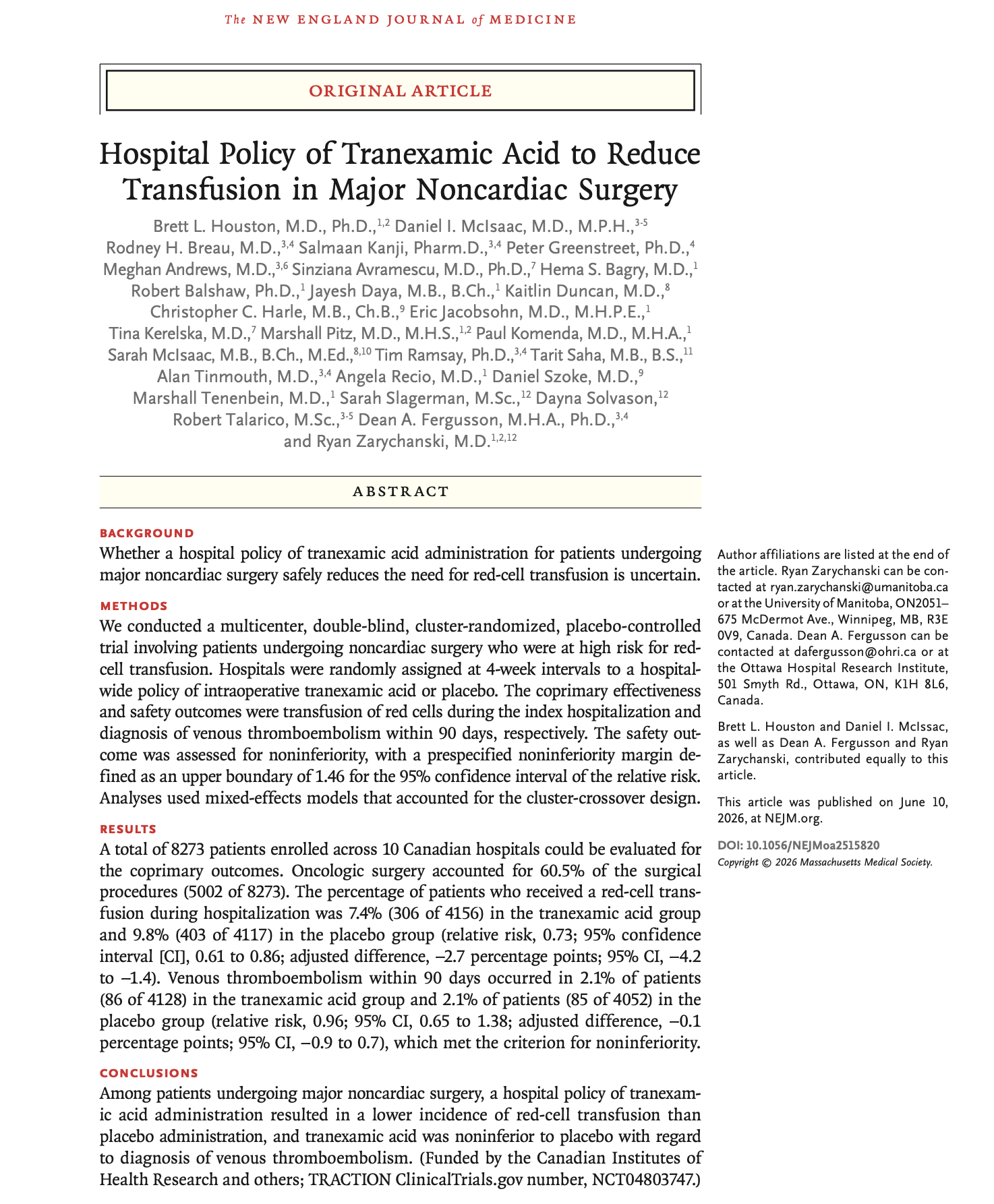
Exciting news from the TRACTION trial team: our findings are now published in the New England Journal of Medicine, demonstrating that tranexamic acid reduces red-cell transfusions without increasing the risk of blood clots in major noncardiac surgery.
Read the full article to learn more about what this means for patients and surgical practice.
Trial Overview
-

8273 Patients Enrolled - Complete
-

10 Participating Sites
-

OHRI Database
Funders & Collaborators






Trial Description
The TRACTION Trial was a national multi-centre Phase IV randomized cluster-crossover trial comparing Tranexamic acid versus placebo. Participating centres were randomly allocated to receive either TXA or matching placebo at 1-month intervals, with co-primary outcomes designed to evaluate effectiveness in the context of safety.
Trial Synopsis

● TITLE: A Phase IV trial of a hospital policy of Tranexamic acid use to reduce transfusion in major non-cardiac surgery (TRACTION)
● SHORT TITLE: Tranexamic acid to reduce transfusion in major non-cardiac surgery
● TRIAL DESIGN: Pragmatic, randomized cluster-crossover trial.
● PLANNED SAMPLE SIZE OF TRIAL PARTICIPANTS: Approximately 8320 patients 18 years of age and with Increased local fibrinolysis undergoing surgeries known to have a baseline transfusion rate of 5% or greater.
● INVESTIGATIONAL MEDICINAL PRODUCT(s): Tranexamic acid (TXA)
● FORMULATION, DOSE, ROUTE OF ADMINISTRATION: TXA 1 gram intravenous bolus followed by 1 additional gram prior to skin closure.
● DURATION: From first surgical incision until skin closure.
● FOLLOW UP DURATION: 90 days
● PLANNED TRIAL PERIOD: 18 months
● PRIMARY OUTCOMES: Co-primary outcomes include: a) the proportion of patients transfused red blood cells (RBCs); and b) the incidence of deep vein thrombosis or pulmonary embolus within 3 months of surgery.
● SECONDARY OUTCOMES: (1) Transfusion: The number of RBC units transfused, both at an individual-level and at a cluster-level; (2) Safety: In-hospital diagnosis of myocardial infarction, stroke, deep vein thrombosis or pulmonary embolus; (3) Clinical: Hospital length of stay, ICU admission, hospital survival, 3-month survival, and the number of days at home to day 30 (DAH30); 4) Compliance: proportion of eligible patients who receive the policy intervention, and the policy compliance in enrolled patients.
Our Team

Dr. Zarychanski
Dr. Zarychanski is a Professor, Critical Care physician, Hematologist, and Clinician-Scientist at the University of Manitoba and CancerCare Manitoba.
Principal Investigator
Dr. Brett Houston
Dr. Houston is an Assistant Professor, Hematologist, and Clinician-Scientist at the University of Manitoba and CancerCare Manitoba. Her PhD thesis focused on the use of tranexamic acid to reduce bleeding in non-cardiac surgeries at high-risk for red blood cell transfusion.
Principal Investigator
Dayna Solvason
Co-Director, Aurora Clinical Research/TRACTION Trial; Clinical Trial Operations ManagerDayna Solvason is a Research Project Manager with over 16 years of experience in academic and industry-sponsored clinical health research. She specializes in clinical trial operations of multi-center national and international clinical trials, including clinical trial agreements, and international clinical trial insurance requirements.